30+ Excellent Windows Phone 7 Development Tutorials
http://blogs.msdn.com/b/lebanon/archive/2011/01/03/30-excellent-windows-phone-7-development-tutorials.aspx
Windows Phone Programming in VB.NET
http://www.myvbprof.com/MainSite/index.aspx#/zWP7_Part1
Sqlite Client for Windows Phone
http://sqlitewindowsphone.codeplex.com/
Friday, July 08, 2011

Sunday, July 03, 2011
MS: IIS error Unrecognized attribute 'targetFramework'. Note that attribute names are case-sensitive
After install .NET Framework 4.0 on IIS 7 and deploying a .NET 4.0 (Visual Studio 2010) web site, you receive the following error: "Unrecognized attribute 'targetFramework'. Note that attribute names are case-sensitive"
Solution:
Select the site and on the Actions pane select Basic Settings. Use the Select button on the Application Pool to change the DefaultAppPool to ASP.NET v4.0
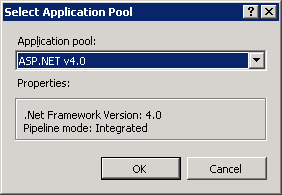
Restart the IIS site.
Solution:
Select the site and on the Actions pane select Basic Settings. Use the Select button on the Application Pool to change the DefaultAppPool to ASP.NET v4.0

Restart the IIS site.
Monday, June 27, 2011
MS: SharePoint 2010 Configuration Failed - Failed to Create the Configuration Database
When you try to configure SharePoint 2010 to connect to a SQL Server using a non standard port, you will receive an error: Failed to create the configuration database.
An exception of type System.ArgumentException was thrown. Additional exception information: [Server Name or IP Address],[Port] is an invalid or loopback access. Specify a valid server address.
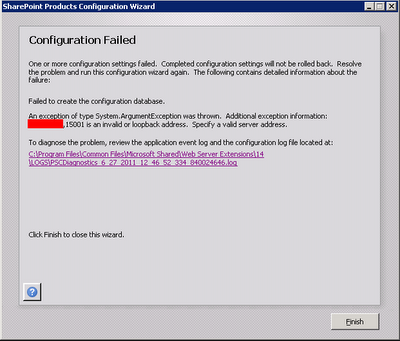 Solution:
An exception of type System.ArgumentException was thrown. Additional exception information: [Server Name or IP Address]
Solution:- Open odbcad32 tool.
- Select the System DSN tab.
- Add a new System Data Source: SQL Server.
- Type the SQL server name on both Name and Server fields on the fist page.
- On the second page, click on the Client Configuration button, unchecks the Dynamically Determine Port checkbox and enter the port number.
Tuesday, June 14, 2011
My book Getting Started with Citrix XenApp 6 is available!!
My new book "Getting Started with Citrix XenApp 6" by Packt Publishing is now available. You can order it at Packtpub.com
XenApp 6 is the leader in application hosting and virtualization delivery, allowing users from different platforms such Windows, Mac, Linux, and mobile devices to connect to their business applications. It reduces resources and costs for application distribution and management. Using Citrix XenApp 6, you can deploy secure applications quickly to thousands of users.
Getting Started with Citrix XenApp 6 provides comprehensive details on how to design, implement, and maintain Citrix farms based on XenApp 6. Additionally, you will learn to use management tools and scripts for daily tasks such as managing servers, published resources, printers, and connections.
Getting Started with Citrix XenApp 6 starts by introducing the basics of XenApp such as installing servers and configuring components, and then teaches you how to publish applications and resources on the client device before moving on to configuring content redirection.
Author Guillermo Musumeci includes a use case throughout the book to explain advanced topics like creating management scripts and deploying and optimizing XenApp for Citrix XenServer, VMware ESX, and Microsoft Hyper-V virtual machines. It will guide you through an unattended installation of XenApp and components on physical servers. By the end of this book you will have enough knowledge to successfully design and manage your own XenApp 6 Farms.
A complete guide to managing a virtualized application environment using XenApp
What you will learn from this book :
- New features and system requirements of XenApp 6
- The XenApp Architecture and designing XenApp 6 Farms
- Install XenApp 6 and configure XenApp 6 components
- Manage XenApp components and Citrix Administrators using the new Citrix Delivery Services Console and other Management tools
- Publish and manage applications and resources, including application streaming
- Create and apply Citrix Policies to control connections, security, and bandwidth settings using the Group Policy Management Console, Citrix Delivery Services Console, and Local Group Policy Editor.
- Optimize multimedia content on XenApp using Citrix HDX technologies
- Manage session environments and connections
- Create PowerShell Scripts to manage the farm and call scripts from VB.NET and C#.NET
- Deploy XenApp 6 on Citrix XenServer, Microsoft Hyper-V, and VMware ESX virtual machines
Unattended installation of XenApp 6 on physical servers.
Approach
This book has a tutorial style with step-by-step instructions and adequate screenshots for carrying out each task.
Friday, April 15, 2011
Love this
Beautiful! Nothink like found a hard drive containing a folder called absolute critical with no free space! 

Tuesday, March 15, 2011
Working on a big company with thousands of Citrix servers around the world running multiples version of XenApp and Presentation server is the perfect scenario to found removing MFCOM can be one of the big mistakes of Citrix on years.
In very distributed and secure environments with multiples domains PowerShell is just not working to manage remote servers as well MFCOM can do it.
I hope Citrix will release a Future Pack to provide full access to MFCOM soon, or adoption level of XA6 will keep low…. And companies will keep running old versions or migrate to XA5!!!
Nobody will rewrite hundred of scripts and tools to Powershell, because NOBODY are using PowerShell, maybe in a few years...
In very distributed and secure environments with multiples domains PowerShell is just not working to manage remote servers as well MFCOM can do it.
I hope Citrix will release a Future Pack to provide full access to MFCOM soon, or adoption level of XA6 will keep low…. And companies will keep running old versions or migrate to XA5!!!
Nobody will rewrite hundred of scripts and tools to Powershell, because NOBODY are using PowerShell, maybe in a few years...
Tuesday, February 01, 2011
MS: Events 1085 and 8194 on Windows 2008 - Group Policy Issues
A full hard disk caused the following errors to appears on event viewer in a Windows Server 2008 running Terminal Server and Citrix XenApp. The lack of space caused a GPO corruption on the server.

Log Name: System
Source: Microsoft-Windows-GroupPolicy
Event ID: 1085
Level: Warning
Description:Windows failed to apply the Group Policy "MyPolicy" settings. Group Policy "MyPolicy" settings might have its own log file. Please click on the "More information" link.

Log Name: Application
Source: Group Policy Start Menu Settings
Event ID: 8194
Level: Error
Description: The client-side extension could not remove user policy settings for 'MyPolicy' because it failed with error code '0x8007000d The data is invalid.' See trace file for more details.
SOLUTION: Delete the content of folder C:\ProgramData\Microsoft\Group Policy\History, run GPUPDATE /FORCE and reboot server.

Log Name: System
Source: Microsoft-Windows-GroupPolicy
Event ID: 1085
Level: Warning
Description:Windows failed to apply the Group Policy "MyPolicy" settings. Group Policy "MyPolicy" settings might have its own log file. Please click on the "More information" link.

Log Name: Application
Source: Group Policy Start Menu Settings
Event ID: 8194
Level: Error
Description: The client-side extension could not remove user policy settings for 'MyPolicy' because it failed with error code '0x8007000d The data is invalid.' See trace file for more details.
SOLUTION: Delete the content of folder C:\ProgramData\Microsoft\Group Policy\History, run GPUPDATE /FORCE and reboot server.
Friday, January 28, 2011
MS: Terminal Server issue - Error 4105
Error:
Log Name: System
Source: Microsoft-Windows-TerminalServices-Licensing
Event ID: 4105
Level: Warning
Description:
The Remote Desktop license server cannot update the license attributes for user "user" in the Active Directory Domain "domain.com". Ensure that the computer account for the license server is a member of Terminal Server License Servers group in Active Directory domain "domain.com".If the license server is installed on a domain controller, the Network Service account also needs to be a member of the Terminal Server License Servers group.If the license server is installed on a domain controller, after you have added the appropriate accounts to the Terminal Server License Servers group, you must restart the Remote Desktop Licensing service to track or report the usage of RDS Per User CALs.Win32 error code: 0x80070005

This issue is caused by missing Terminal server attributes on Windows 2008 R2 Active Directory Domains. This issue can cause issues on Citrix logins.
Solution:
cls
$root = New-Object DirectoryServices.DirectoryEntry
$URL$ds = New-Object DirectoryServices.DirectorySearcher
$ds.SearchRoot = $root
$ds.filter = "objectCategory=Person"
$src = $ds.findall()
write-host "Found" $src.count "user objects.`n"
$src %{
$de = $_.getdirectoryentry()
$accessrules = $de.get_objectsecurity().getaccessrules($true, $false,[System.Security.Principal.SecurityIdentifier]) ?{$_.ObjectType -eq "5805bc62-bdc9-4428-a5e2-856a0f4c185e"}
if ((measure-object -inputobject $accessrules).count -eq 0)
{
$ar = new-object System.DirectoryServices.ActiveDirectoryAccessRule([System.Security.Principal.SecurityIdentifier]"S-1-5-32-561", 48, "Allow", [guid]"5805bc62-bdc9-4428-a5e2-856a0f4c185e")
$de.get_objectsecurity().addaccessrule($ar)
$de.commitchanges()
write-host -f yellow ("Added:`t" + $de.properties["sAMAccountName"])
start-sleep -m 200
}
else
{
write-host -f green ("OK:`t" + $de.properties["sAMAccountName"])
}
}
Log Name: System
Source: Microsoft-Windows-TerminalServices-Licensing
Event ID: 4105
Level: Warning
Description:
The Remote Desktop license server cannot update the license attributes for user "user" in the Active Directory Domain "domain.com". Ensure that the computer account for the license server is a member of Terminal Server License Servers group in Active Directory domain "domain.com".If the license server is installed on a domain controller, the Network Service account also needs to be a member of the Terminal Server License Servers group.If the license server is installed on a domain controller, after you have added the appropriate accounts to the Terminal Server License Servers group, you must restart the Remote Desktop Licensing service to track or report the usage of RDS Per User CALs.Win32 error code: 0x80070005

This issue is caused by missing Terminal server attributes on Windows 2008 R2 Active Directory Domains. This issue can cause issues on Citrix logins.
Solution:
Run the following powershell script. The script MUST run on PowerShell 2.0 and with administrator permissions (right click on the powershell icon and select Run as Administrator. Modify the domain name in the script.
$URL = ldap://DC=mydomain,DC=com/;
cls
$root = New-Object DirectoryServices.DirectoryEntry
$URL$ds = New-Object DirectoryServices.DirectorySearcher
$ds.SearchRoot = $root
$ds.filter = "objectCategory=Person"
$src = $ds.findall()
write-host "Found" $src.count "user objects.`n"
$src %{
$de = $_.getdirectoryentry()
$accessrules = $de.get_objectsecurity().getaccessrules($true, $false,[System.Security.Principal.SecurityIdentifier]) ?{$_.ObjectType -eq "5805bc62-bdc9-4428-a5e2-856a0f4c185e"}
if ((measure-object -inputobject $accessrules).count -eq 0)
{
$ar = new-object System.DirectoryServices.ActiveDirectoryAccessRule([System.Security.Principal.SecurityIdentifier]"S-1-5-32-561", 48, "Allow", [guid]"5805bc62-bdc9-4428-a5e2-856a0f4c185e")
$de.get_objectsecurity().addaccessrule($ar)
$de.commitchanges()
write-host -f yellow ("Added:`t" + $de.properties["sAMAccountName"])
start-sleep -m 200
}
else
{
write-host -f green ("OK:`t" + $de.properties["sAMAccountName"])
}
}
Friday, January 21, 2011
CTX: Windows 7 and Office 2010 running XenDesktop 5 @iPad
I'm working on a XenDesktop 5 PoC (Proof of concept).
This is a iPad running Windows 7 and Office 2o1o! How amazing is this!

Right-Click and Audio are two issues I found on the pilot.
This is a iPad running Windows 7 and Office 2o1o! How amazing is this!

Right-Click and Audio are two issues I found on the pilot.
CTX: Exchange is unavailable error on Citrix or Terminal Server
When a user opens Outlook on Citrix XenApp (or Terminal Server) running on Windows 2008, he received an error: “Exchange is unavailable”.
They are several reasons for this issue:
1) Network issues:
Check network connection. Check if network gateway is ok. Reset the network connection.
2) Cached Profiles:
They are several reasons for this issue:
1) Network issues:
Check network connection. Check if network gateway is ok. Reset the network connection.
2) Cached Profiles:
- Check the date of cached profile folder for the user on the C:\Users folder. If the date is from previous days, ask user to log off and delete the cached profile. Also delete any temp folder, they are corrupted profiles.
- Check Profile List and delete key with .bak at the end in HKEY_LOCAL_MACHINE\SOFTWARE\Microsoft\Windows NT\CurrentVersion\ProfileList. Compare users in task manager and delete profiles from not connected users too.
Note: you can enable a GPO to delete profiles when users log off from a session.
Open Group Policies Management console. Expand Computer Configuration, expand Administrative Templates, expand System, and then expand User Profiles.
Double-click Delete cached copies of roaming profiles, click Enabled
This GPO not always is working properly. A process lock the profile and some pieces of the profile still on folder. You can enable a GPO to delete profiles older than XX days when server is rebooted, to delete these profiles.
Open Group Policies Management console. Expand Computer Configuration, expand Administrative Templates, expand System, and then expand User Profiles. Double-click Delete user profiles older than a specified number of days on system restart and type amount of days.Thursday, December 30, 2010
EXCHANGE: Apply to Mailbox Retention Policy to Security Group Members
This powershell script will apply a Mailbox Retention Policy to a Active Directory Security Group Members
This script require Quest ActiveRoles Management Shell for Active Directory, available for FREE at http://www.quest.com/powershell/
To add the ActiveRoles Management Shell snap-in from Windows PowerShell
At the Windows PowerShell prompt, enter the following command:
Add-PSSnapin Quest.ActiveRoles.ADManagement
This is the script:
Get-QADGroupMember 'Exchange Retention Exception' | ForEach-Object {set-Mailbox $_.Name -ManagedFolderMailboxPolicy "Managed-Folders-60-Days"}
This script require Quest ActiveRoles Management Shell for Active Directory, available for FREE at http://www.quest.com/powershell/
To add the ActiveRoles Management Shell snap-in from Windows PowerShell
At the Windows PowerShell prompt, enter the following command:
Add-PSSnapin Quest.ActiveRoles.ADManagement
This is the script:
Get-QADGroupMember 'Exchange Retention Exception' | ForEach-Object {set-Mailbox $_.Name -ManagedFolderMailboxPolicy "Managed-Folders-60-Days"}
Wednesday, December 15, 2010
MS: set color quality to 32 bit when RDP VMware VMs
When I RDP a VMware Virtual Machine (VM) running Windows Server 2008. The color quality is 16 bit even if we set 32 bit on Remote Desktop Client.
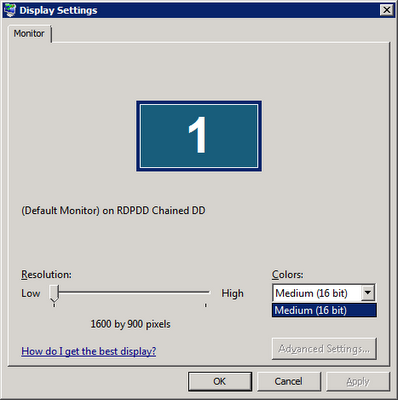
Solution: modify the local policy using gpedit.msc and modify following policy:
Computer Configuration, Administrative Templates, Windows Components, Terminal Services, Terminal Server, Remote Session Environment
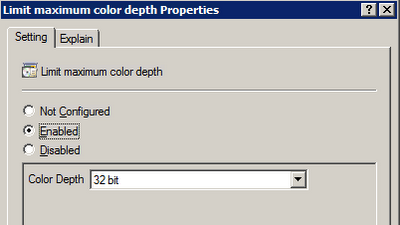
Solution: modify the local policy using gpedit.msc and modify following policy:
Computer Configuration, Administrative Templates, Windows Components, Terminal Services, Terminal Server, Remote Session Environment

MS: Report items amount and size of each manage folder in Exchange
This powershell script will show how many items and size of each managed folder of all users in a Exchange 2007/2010 organization.
Get-Mailbox foreach { $mbx = $_.DisplayName; Get-MailboxFolderStatistics $_.identity -FolderScope 'Managed Folders' select @{n="DisplayName";e={$mbx}},FolderPath,ItemsInFolder,@{n="FolderSize(MB)";e={$_.folderSize.toMB()}}} export-csv c:\reports\ManagedFolders_12152010.csv
Get-Mailbox foreach { $mbx = $_.DisplayName; Get-MailboxFolderStatistics $_.identity -FolderScope 'Managed Folders' select @{n="DisplayName";e={$mbx}},FolderPath,ItemsInFolder,@{n="FolderSize(MB)";e={$_.folderSize.toMB()}}} export-csv c:\reports\ManagedFolders_12152010.csv
Monday, December 13, 2010
MS: Windows 2008 Profile Loading Error
Check Profile List and delete key with .bak at the end.
HKEY_LOCAL_MACHINE\SOFTWARE\Microsoft\Windows NT\CurrentVersion\ProfileList
HKEY_LOCAL_MACHINE\SOFTWARE\Microsoft\Windows NT\CurrentVersion\ProfileList
Tuesday, November 30, 2010
MS: E-mail Records Management and E-mail Retention
Great posts of Adam Harmetz @ Microsoft Records Management Team Blog about e-mail retention in Exchange 2007:
http://blogs.msdn.com/b/recman/archive/2006/12/19/email-records-management-part-1.aspx
http://blogs.msdn.com/b/recman/archive/2007/01/05/e-mail-records-management-part-2.aspx
http://blogs.msdn.com/b/recman/archive/2007/01/18/e-mail-records-management-part-3-e-mail-retention.aspx
http://blogs.msdn.com/b/recman/archive/2006/12/19/email-records-management-part-1.aspx
http://blogs.msdn.com/b/recman/archive/2007/01/05/e-mail-records-management-part-2.aspx
http://blogs.msdn.com/b/recman/archive/2007/01/18/e-mail-records-management-part-3-e-mail-retention.aspx
MS: Create a Managed Folder Mailbox Policy on Exchange 2007 or 2010
Create a Managed Folder Mailbox Policy on Exchange 2007 or 2010
Create a Managed Custom Folder
>> Open Exchange Management Console.
>> Expand the Organization Configuration node and then click Mailbox.
>> Click in Managed Custom Folder tab
>> Right-click and choose the New Managed Custom Folder
>> The New Managed Custom Folder wizard appears. Complete required information.
Also we can use the following example cmdlet:
New-ManagedFolder -Name '3 Months Retention' -FolderName '3 Months Retention' StorageQuota 'unlimited'
Create a Managed Folder Mailbox Policy
>> Open Exchange Management Console.
>> Expand the Organization Configuration node and then click Mailbox.
>> Click in Managed Folder Mailbox Policies tab
>> Right-click and choose the New Managed Folder Mailbox Policy
>> The New Managed Folder Mailbox Policy wizard appears. Complete required information.
Also we can use the following example cmdlet:
new-ManagedFolderMailboxPolicy -Name "RetentionPolicy" -ManagedFolderLinks "3 Months Retention"
Assign the policy to a mailbox
>> Open Exchange Management Console.
>> Expand Recipient Configuration.
>> Double click on the desired mailbox.
>> Click on Mailbox Settings tab.
>> Select Message Records Management.
>> Click on Properties button.
>> Select the Managed Folder Mailbox Policy and make sure that Managed folder mailbox policy checkbox is checked.
Also we can use the following example cmdlet to apply to policy to a single mailbox:
Set-Mailbox -Identity GMusumeci -ManagedFolderMailboxPolicy "RetentionPolicy"
The following example cmdlet apply to policy to multiple mailboxes:
Get-Mailbox -database "EXCHSRV01\Storage Group 1\Mailbox Database 1" Set-Mailbox -ManagedFolderMailboxPolicy "RetentionPolicy"
Force the updates
We can force at server level or user level, using following two cmdlets:
Start-ManagedFolderAssistant –Identity EXCHSRV01
Start-ManagedFolderAssistant –Mailbox GMusumeci
Create a Managed Custom Folder
>> Open Exchange Management Console.
>> Expand the Organization Configuration node and then click Mailbox.
>> Click in Managed Custom Folder tab
>> Right-click and choose the New Managed Custom Folder
>> The New Managed Custom Folder wizard appears. Complete required information.
Also we can use the following example cmdlet:
New-ManagedFolder -Name '3 Months Retention' -FolderName '3 Months Retention' StorageQuota 'unlimited'
Create a Managed Folder Mailbox Policy
>> Open Exchange Management Console.
>> Expand the Organization Configuration node and then click Mailbox.
>> Click in Managed Folder Mailbox Policies tab
>> Right-click and choose the New Managed Folder Mailbox Policy
>> The New Managed Folder Mailbox Policy wizard appears. Complete required information.
Also we can use the following example cmdlet:
new-ManagedFolderMailboxPolicy -Name "RetentionPolicy" -ManagedFolderLinks "3 Months Retention"
Assign the policy to a mailbox
>> Open Exchange Management Console.
>> Expand Recipient Configuration.
>> Double click on the desired mailbox.
>> Click on Mailbox Settings tab.
>> Select Message Records Management.
>> Click on Properties button.
>> Select the Managed Folder Mailbox Policy and make sure that Managed folder mailbox policy checkbox is checked.
Also we can use the following example cmdlet to apply to policy to a single mailbox:
Set-Mailbox -Identity GMusumeci -ManagedFolderMailboxPolicy "RetentionPolicy"
The following example cmdlet apply to policy to multiple mailboxes:
Get-Mailbox -database "EXCHSRV01\Storage Group 1\Mailbox Database 1" Set-Mailbox -ManagedFolderMailboxPolicy "RetentionPolicy"
Force the updates
We can force at server level or user level, using following two cmdlets:
Start-ManagedFolderAssistant –Identity EXCHSRV01
Start-ManagedFolderAssistant –Mailbox GMusumeci
Tuesday, November 23, 2010
MS: Get Exchange Mailbox Info (Exchange 2007 / 2010 or later)
This PowerShell script show the size of the Inbox folder and export the result to CSV file (excel)
Get-Mailbox foreach { $mbx = $_.DisplayName; Get-MailboxFolderStatistics $_.identity -FolderScope 'Inbox' select @{n="DisplayName";e={$mbx}},FolderPath,ItemsInFolder,@{n="FolderSize(MB)";e={$_.folderSize.toMB()}}} export-csv c:\Inbox.csv
This is another script to show the size of the Inbox folder and export the result to CSV file (excel)
Get-Mailbox -ResultSize Unlimited Select-Object Name, @{n='Inbox';e={(Get-MailboxFolderStatistics $_.Identity -FolderScope Inbox).FolderAndSubfolderSize.ToMb() }} Export-Csv c:\Inbox.csv -NoTypeInformation
Get-Mailbox foreach { $mbx = $_.DisplayName; Get-MailboxFolderStatistics $_.identity -FolderScope 'Inbox' select @{n="DisplayName";e={$mbx}},FolderPath,ItemsInFolder,@{n="FolderSize(MB)";e={$_.folderSize.toMB()}}} export-csv c:\Inbox.csv
This is another script to show the size of the Inbox folder and export the result to CSV file (excel)
Get-Mailbox -ResultSize Unlimited Select-Object Name, @{n='Inbox';e={(Get-MailboxFolderStatistics $_.Identity -FolderScope Inbox).FolderAndSubfolderSize.ToMb() }} Export-Csv c:\Inbox.csv -NoTypeInformation
Thursday, November 11, 2010
VMware: VMUpgradeHelper service was unable to get the list of network adaptars for this computer
Error: The service was unable to get the list of network adapters for this computer. This problem can occur when the Windows Management Instrumentation service is not started. Please check that the Windows Management Instrumentation service has been started on this computer.
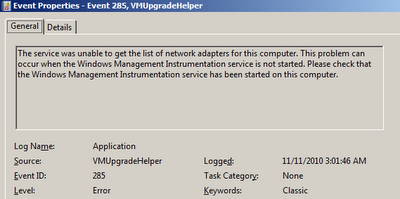 Solution: This issue is caused by WMI on server. Verify WMI service is running. Rebuild the WMI using following article http://musumeci.blogspot.com/2010/11/ms-windows-management-instrumentation.html
 Solution: This issue is caused by WMI on server. Verify WMI service is running. Rebuild the WMI using following article http://musumeci.blogspot.com/2010/11/ms-windows-management-instrumentation.html
CTX: Edgesight is reporting Device Model as [Unknown]
Error: When you check the Edgesight console, you will found Device Model shows [Unknown]
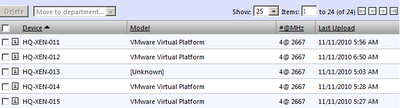 Solution: This issue is caused by WMI on Citrix server. Verify WMI service is running. Rebuild the WMI using following article http://musumeci.blogspot.com/2010/11/ms-windows-management-instrumentation.html
 Solution: This issue is caused by WMI on Citrix server. Verify WMI service is running. Rebuild the WMI using following article http://musumeci.blogspot.com/2010/11/ms-windows-management-instrumentation.html
Wednesday, November 10, 2010
CTX: How to Import ICAClient.adm file into Active Directory to modify Citrix Plug-in client settings using GPO
How to Import ICAClient.adm file into Active Directory to modify Citrix Plug-in (formerly known as ICA Client) client settings using GPO.
http://xenapp6.musumeci.com.ar/TechnicalNotes/How_to_Import_ICAClient.adm_file.html
http://xenapp6.musumeci.com.ar/TechnicalNotes/How_to_Import_ICAClient.adm_file.html
Subscribe to:
Posts (Atom)